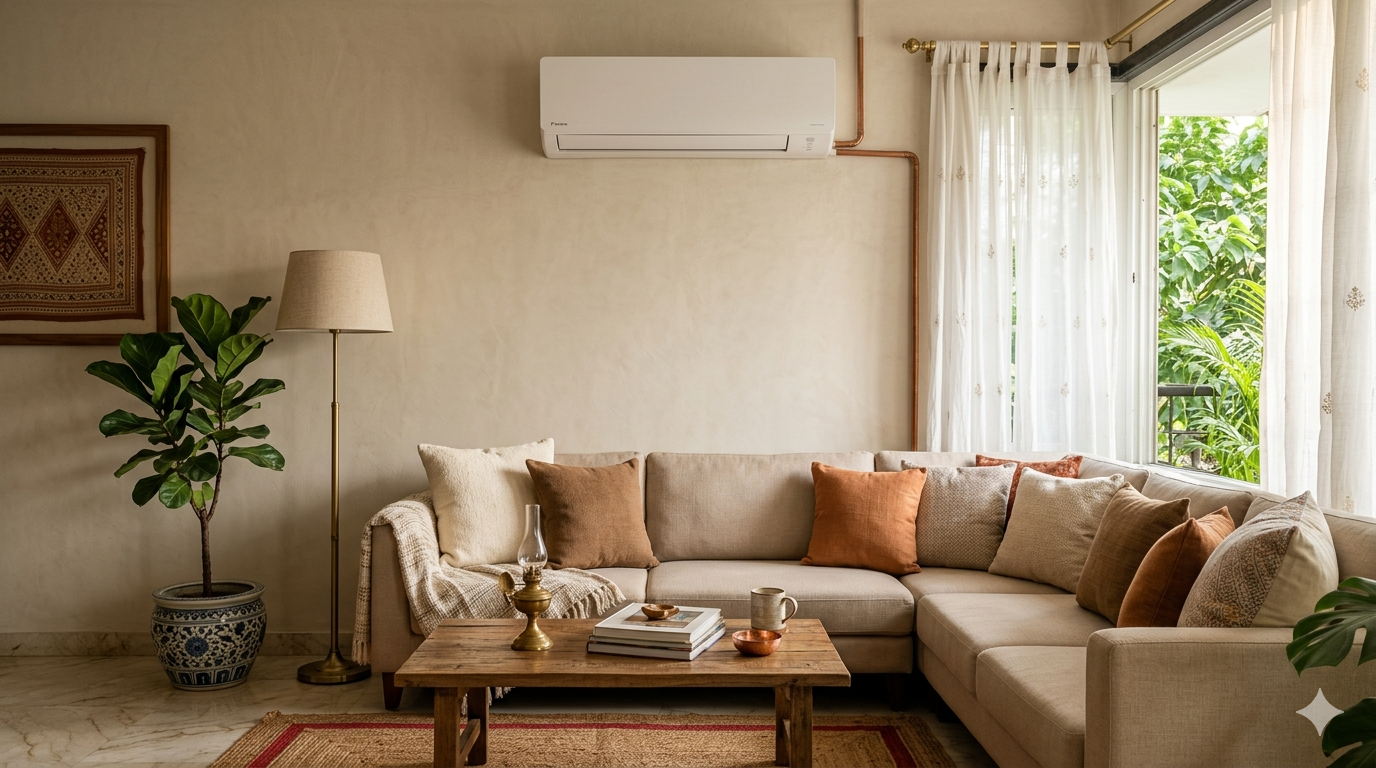
Indian summers now last eight months. From late February to October, an air conditioner stops being a luxury and becomes a basic appliance. Most Indian apartments built in the last decade are designed assuming AC use — the ventilation simply does not work well enough during peak summer without one.
The 1.5-ton inverter split AC under ₹50,000 is the practical sweet spot for Indian buyers. Cool enough for most apartment bedrooms and small living rooms. Energy efficient enough to keep monthly bills reasonable. Available from every major brand with strong service networks across Indian cities.
But the segment is also where the most marketing confusion happens. Six-in-one convertible, stabilizer-free, anti-virus filters, Wi-Fi smart features, voice control, PM 2.5 filtration, sleep mode, turbo cooling — every model in this price range claims a dozen features that may or may not matter for your specific situation. This guide cuts through the noise and identifies the five inverter ACs genuinely worth buying under ₹50,000 in India in 2026, plus the things that actually affect your purchase decision.
Note on pricing: We initially aimed to cover this segment at ₹40,000 but 2026 market reality is that the strongest 5-star models with current ISEER ratings have settled in the ₹38,000 to ₹48,000 range. Pricing under ₹40,000 increasingly means compromising on either efficiency rating or feature set. The ₹50,000 cap captures the genuinely worth-buying picks without straying into premium ₹60,000-plus territory.
The Two Numbers That Actually Matter
Before any product recommendation, two specifications determine whether an AC will work for your home over the next ten years.
The first is ISEER, which stands for Indian Seasonal Energy Efficiency Ratio. This is the official BEE rating for AC energy efficiency, measured under conditions designed to reflect Indian usage patterns. The 2026 BEE 5-star minimum is 4.6. The current market-leading ISEER for 1.5-ton split ACs is 5.80 on the Panasonic CS-CU-NU18BKY5WX. Any inverter AC under ₹50,000 with ISEER 4.6 or above is genuinely efficient. ISEER 5.0 or above places it in the top tier of energy savings.
The second is cooling capacity in BTU or kilowatts. A 1.5-ton AC delivers 18,000 BTU per hour, suitable for rooms up to 180 square feet under most conditions. For Delhi summers where ambient temperatures cross 45°C, derate that by about 25 percent — a 1.5-ton in Delhi during May effectively cools about 130-140 square feet. For Chennai or Mumbai with high humidity, the effective coverage drops further due to the cooling system also working to dehumidify.
These two numbers determine whether the AC will actually cool your room and at what running cost. Everything else — convertible modes, Wi-Fi, design — is secondary.
What Star Rating Actually Costs You
The difference between a 3-star and 5-star inverter AC sounds small. ISEER 3.5 versus ISEER 5.0. The real-world cost difference is significant.
A 1.5-ton 3-star inverter AC running 8 hours daily during the summer season uses approximately 290 units of electricity per month. At Indian residential tariffs of ₹7-9 per unit depending on city, that is ₹2,030 to ₹2,610 per month. Over a 7-month cooling season, that is ₹14,200 to ₹18,270.
A 1.5-ton 5-star inverter AC at the same usage uses approximately 195 units monthly. At the same tariffs, that is ₹1,365 to ₹1,755 per month. Over the cooling season, that is ₹9,555 to ₹12,285.
The annual saving for choosing 5-star over 3-star is ₹4,645 to ₹5,985 per year. Over the ten-year typical AC lifespan, this is ₹46,000 to ₹60,000 in saved electricity bills — significantly more than the typical ₹6,000 to ₹8,000 price difference between 3-star and 5-star models at the same tonnage.
Buying a 3-star AC to save ₹6,000 upfront loses you ₹40,000 to ₹50,000 over the AC's lifetime. This single calculation is the most important consumer decision in this category, and it is also the calculation most consumers skip.

The Best Pick Overall

The LG 1.5 Ton 5 Star DUAL Inverter Split AC is the best overall pick under ₹50,000 for Indian homes in 2026. LG's DUAL Inverter compressor has been the most reliable inverter technology in the Indian market for over five years, and this current generation brings industry-leading efficiency at this price point.
The 5.20 ISEER rating delivers approximately ₹4,500 to ₹5,500 annual electricity savings versus a 3-star equivalent. The DUAL Inverter compressor uses two rotors instead of one, providing faster cooling at lower power draw and significantly reduced wear over the AC's lifetime. LG's actual real-world ISEER tracking in independent testing has consistently shown the rated efficiency holds up after five-plus years of use, unlike some competitor brands where efficiency degrades faster.
The AI Convertible 6-in-1 mode allows the AC to run at 40, 60, 80, 100, or 110 percent of rated capacity depending on conditions. The 40 percent mode is useful for shoulder seasons when light cooling is needed. The 110 percent mode boosts cooling capacity above the 1.5-ton rating during peak summer for faster initial cooldown.
Cooling at 55°C ambient is genuinely useful for Indian conditions — North Indian plains regularly cross 50°C during May and June heatwaves. Many competitor ACs are rated only to 48°C ambient and underperform during these peak conditions.
Five-year total cost: approximately ₹78,000. Initial purchase ₹45,990. Five-year electricity bill at 5-star efficiency approximately ₹50,000. Annual service costs ₹2,000 per year. The LG service network is among the largest in India with 24-hour response in most metros and 48-72 hours in tier-2 cities.
The biggest advantage is the 10-year compressor warranty. LG inverter compressors have proven failure rates significantly lower than competitors over years 5-10 of ownership, which is when most AC failures actually occur. The PCB warranty is 5 years, also industry-leading at this price point.
The downsides: build quality is functional rather than premium. Wi-Fi connectivity is not included at this price tier — for app control you need to upgrade to the LG smart variants above ₹50,000. Some buyers report the auto-clean function leaves moisture inside the indoor unit longer than ideal, which can cause minor mildew over years 3-5 without periodic professional cleaning.
Best for Maximum Energy Efficiency

If running cost is your absolute priority, the Panasonic 1.5 Ton 5 Star Wi-Fi DustBuster delivers the highest ISEER rating available for any 1.5-ton split AC in India in 2026 at 5.80. This translates to approximately ₹5,400 annual electricity savings versus a 3-star AC — the lowest running cost in the segment.
The Twin Cool Inverter Compressor adapts cooling capacity continuously from 22 to 110 percent of rated capacity. This means the AC almost never operates at full power once the room cools, which dramatically reduces electricity consumption. In real-world Indian usage, this AC frequently runs at 30-50 percent of rated power for hours at a time during steady-state cooling.
The DustBuster auto-cleaning system is genuinely useful for Indian conditions. Indian outdoor dust and indoor cooking particulates accumulate quickly on AC coils and filters, reducing efficiency by 10-15 percent within months. DustBuster automatically initiates a coil cleaning cycle, extending the gap between professional service visits and maintaining rated efficiency over years of use.
ShieldBlu+ anti-corrosion coating is critical for coastal cities. Mumbai, Chennai, Kolkata, and Kochi have salt-air conditions that significantly accelerate aluminum coil corrosion. Panasonic and LG offer the strongest anti-corrosion protection in this segment.
Wi-Fi smart control through the Panasonic Comfort Cloud app provides remote scheduling, energy usage tracking, and integration with Alexa and Google Home. This is genuinely useful for managing electricity costs — you can ensure the AC turns off when you forget, schedule pre-cooling 15 minutes before arriving home, and track which days your electricity usage spikes.
Five-year total cost: approximately ₹75,000. Initial purchase ₹47,990. Five-year electricity bill at 5.80 ISEER approximately ₹47,000. Annual service ₹2,000.
The trade-off: Panasonic's service network is solid in metros but less dense than LG in tier-2 cities. Service response times can stretch to 4-5 days in non-metro markets during peak summer. For users in Pune, Jaipur, Indore, or Lucknow, factor this into your decision.
Best for Severe Indian Heat (Delhi, Rajasthan)

Voltas is a Tata-owned Indian brand that has dominated Indian AC sales for over a decade. The Vectra Elite is specifically tuned for the heat extremes of North Indian and Rajasthan summers. Where global brands like Samsung and LG sometimes underperform at sustained 48-50°C ambient temperatures, Voltas units are designed to maintain rated cooling output even under prolonged extreme heat.
The 5.10 ISEER puts it just below LG and Panasonic on efficiency but ahead of most other Indian-tuned brands. The 4-in-1 Adjustable Mode allows operation at 50, 75, 100, or 110 percent of rated capacity. The 110 percent boost mode is genuinely useful in Indian conditions where rooms need rapid cooldown after returning from work to a sun-baked apartment.
The Indian-specific tuning extends beyond the rated specifications. Voltas's testing for Indian conditions includes voltage fluctuation tolerance (140V to 280V stabilizer-free operation), dust resistance for tier-2 city pollution conditions, and humidity handling for both dry north Indian summers and humid coastal climates.
Five-year total cost: approximately ₹72,000. Initial purchase ₹42,990. Voltas has the largest service network in India with over 25,000 service touchpoints, which is significantly more than any global brand. Service response in tier-2 and tier-3 cities is typically faster than competitor brands.
The trade-off: Voltas does not match LG or Panasonic on premium feel. The indoor unit casing feels less premium than competitors. Noise level at full speed is 44 dB, slightly louder than the LG (42 dB) and Panasonic (41 dB) picks. For bedroom use, this is noticeable; for living room use, it is irrelevant.
Best for Heavy-Duty Cooling and Build Quality

Blue Star is an Indian brand with deep roots in commercial cooling. Their consumer ACs benefit from this commercial heritage — heavier-duty build quality, more robust compressors rated for longer continuous operation, and better tolerance for tough Indian conditions.
The 5.41 ISEER places this firmly in the top tier of efficiency, beating both LG and Voltas. The IoT Connected feature provides Wi-Fi app control and integration with smart home systems. The Turbo Cool mode reaches rated cooling temperature in under 60 seconds for typical room sizes — useful when returning to a hot apartment.
The 5-in-1 convertible mode is genuinely flexible. Modes include 40, 60, 80, 100, and 110 percent of rated capacity. Importantly, the lower-capacity modes are accompanied by significantly reduced power draw, not just slower compressor operation.
Five-year total cost: approximately ₹69,000. Initial purchase ₹41,990 (often the lowest-priced premium 5-star option at this efficiency level). Blue Star service is strong in commercial markets and reasonable in residential markets, particularly in metros.
The trade-off: Blue Star's brand awareness in residential is lower than LG or Voltas. Resale value is lower if you plan to upgrade in 5-7 years. The design aesthetic is more functional than stylish — Blue Star units look like commercial-grade equipment rather than premium home appliances.
Best Budget 3-Star Option (Under ₹40,000)

If your budget is genuinely capped under ₹40,000, the Lloyd 1.5 Ton 3 Star Inverter Convertible is the strongest 3-star option in 2026. We have repeatedly recommended against 3-star ACs in this guide for energy efficiency reasons, but we acknowledge that not every buyer has the budget flexibility to choose 5-star.
The Lloyd 3-star at ISEER 3.81 is meaningfully more efficient than the BEE 3-star minimum of 3.30. This makes it the best-positioned 3-star in the segment — closer to the efficiency of a budget 4-star than a worst-case 3-star. The 4-in-1 convertible mode provides flexibility down to 50 percent capacity for lower power draw during light cooling needs.
Lloyd is a Havells subsidiary, which means it benefits from the Havells service network across India. Service availability in tier-2 cities is significantly stronger than what you might expect for a value-positioned brand.
Five-year total cost: approximately ₹77,000. Initial purchase ₹35,990. Five-year electricity bill at 3.81 ISEER approximately ₹68,000 — significantly higher than the 5-star picks despite lower upfront cost.
The honest assessment: this AC saves you ₹6,000 to ₹10,000 upfront versus the 5-star LG pick but costs you ₹15,000 to ₹20,000 more in electricity over five years. The math only works if you genuinely cannot afford the higher upfront cost and need to spread the financial impact across years of electricity bills rather than absorbing it at purchase.

Installation Reality — The Hidden Cost
Most online AC listings advertise the unit price without including installation. Standard split AC installation costs ₹2,500 to ₹5,000 depending on city and complexity. For tier-1 cities, expect ₹3,000 to ₹4,500. For tier-2 cities, ₹2,500 to ₹3,500.
Additional installation costs are common and rarely discussed in product listings. Copper piping beyond standard 3 metres adds ₹400 to ₹600 per metre. Electrical wiring upgrades for proper AC circuit (with appropriate MCB and dedicated line) typically cost ₹1,500 to ₹3,000. Wall coring for outdoor unit installation adds ₹500 to ₹1,000. Drain pipe extensions can add ₹500 to ₹1,500.
For most Indian apartments, total installation cost from the dealer or Amazon installation partner ranges from ₹3,500 to ₹7,000 above the listed AC price. Factor this into your total budget — a ₹45,000 AC effectively costs ₹49,000 to ₹52,000 by the time it is installed and running.
Self-installation is not recommended. Modern inverter ACs require precise refrigerant levels, vacuum-tested piping, and electrical calibration. Improper installation voids warranty and typically reduces ISEER efficiency by 15-25 percent over the AC's lifetime. The savings from skipping professional installation are erased many times over by higher electricity bills.
Voltage Stabilizers — Do You Need One?
Most premium 5-star ACs are advertised as stabilizer-free, with operational voltage ranges from 140V to 280V (or wider) being typical. In stable electrical supplies, no separate stabilizer is needed.
The exception is areas with frequent voltage swings outside the rated range. Tier-2 and tier-3 cities, some Mumbai outer suburbs, and some Delhi outer areas experience voltage drops below 140V during peak summer evening load or spikes above 280V due to transformer issues. In these areas, a dedicated voltage stabilizer rated for 1.5-ton AC (typical capacity 4 kVA) costs ₹2,500 to ₹4,500 and significantly extends AC lifespan.
A simple test for whether you need a stabilizer — check if your existing appliances (fans, lights, TVs) show visible flickering during peak evening hours. If yes, you likely have voltage issues and a stabilizer is a worthwhile addition.
AC Tonnage Selection — Quick Reference
The right tonnage depends on room size, ceiling height, sun exposure, and city climate. Here are quick guidelines.
For rooms up to 130 square feet (typical small Indian bedroom), 1 ton is sufficient unless the room has significant sun exposure or high ceilings.
For rooms 130 to 180 square feet (typical master bedroom or small living room), 1.5 ton is the right choice. This is the most common AC tonnage in Indian homes and the focus of this guide.
For rooms 180 to 250 square feet (large living room or open-plan kitchen-living), 2 ton is needed. ACs in this tonnage typically exceed our ₹50,000 budget — expect ₹55,000 to ₹70,000 for quality 2-ton 5-star units.
For very hot cities like Delhi, Jaipur, Lucknow, and Patna where summer temperatures cross 45°C frequently, derate the rated tonnage by approximately 25 percent. A 1.5-ton in Delhi effectively cools roughly 130-150 square feet rather than the 180 square feet rated under standard conditions.
For high-humidity cities like Mumbai, Chennai, Kolkata, and Kochi, the AC also has to dehumidify the air, which reduces effective cooling capacity by 15-20 percent. A 1.5-ton AC in Mumbai effectively cools about 140-160 square feet.
Maintenance and Operating Costs Most Reviews Skip
Air conditioner maintenance is not optional. A 1.5-ton split AC requires service approximately every 6 months to maintain rated efficiency. Skipping service does not break the AC immediately but progressively reduces cooling efficiency by 5-10 percent per year, dramatically increasing electricity bills.
Annual maintenance cost: ₹2,000 to ₹3,500 depending on city and service provider. This includes coil cleaning, drain line clearing, filter washing, refrigerant pressure check, and electrical connection inspection.
Filter cleaning between professional services: every 2-3 weeks during peak usage. The indoor unit filter is washable. Cleaning takes 10 minutes. Skipping this single maintenance task reduces airflow by 30-40 percent within 2-3 months, significantly reducing cooling performance and increasing power consumption.
Refrigerant top-up: typically required every 4-5 years. Cost ₹2,000 to ₹3,500 for R32 refrigerant (used in most current 5-star ACs). Models still using R410A or R22 (older refrigerants in some legacy units) cost ₹3,500 to ₹5,000 per top-up.
The honest five-year ownership cost for any 1.5-ton inverter split AC in this segment is:
Initial purchase: ₹42,000 to ₹48,000
Installation: ₹4,000 to ₹6,000
Electricity (5-star efficiency): ₹45,000 to ₹55,000 across 5 years
Maintenance: ₹12,000 to ₹15,000 across 5 years
Total five-year cost: approximately ₹103,000 to ₹124,000
For a 3-star equivalent, the electricity cost component nearly doubles to ₹80,000 to ₹95,000, pushing total five-year ownership higher despite the lower purchase price.
The Honest Verdict
For most Indian homes with typical apartment usage, the LG 1.5 Ton 5 Star DUAL Inverter is the right choice. LG's service network, proven 5-7 year reliability, and balanced feature set make it the safest premium pick under ₹50,000.
If absolute minimum running cost is your priority, the Panasonic 5 Star DustBuster with ISEER 5.80 saves the most electricity over the AC's lifetime — approximately ₹5,400 per year versus a 3-star unit. The DustBuster auto-cleaning is also a genuine functional upgrade for Indian dust conditions.
If you live in Delhi, Rajasthan, or other extreme-heat regions, the Voltas Vectra Elite is genuinely designed for these conditions and outperforms global brands at sustained 48°C-plus ambient temperatures.
If you want strong build quality and the best efficiency-per-rupee, the Blue Star at ₹41,990 with ISEER 5.41 offers the best value in this guide.
If your budget is genuinely capped at ₹40,000, the Lloyd 3-star Convertible is the smartest 3-star choice in 2026 — but understand that you will pay ₹15,000 to ₹20,000 more in electricity over five years than the 5-star equivalent.
The category to avoid is fixed-speed (non-inverter) ACs under ₹35,000. These continue to be sold by some brands and online retailers. They consume 40-50 percent more electricity than equivalent inverter units, fail more frequently, and are noisier in operation. The ₹4,000 to ₹5,000 you save upfront on a fixed-speed AC is erased in less than two years of electricity bills.
Common Questions
How long should an AC last in India? Quality inverter ACs from major brands typically deliver 10-12 years of service in Indian conditions with proper maintenance. Cheap or non-brand ACs frequently fail within 5-7 years.
Should I buy AC during Republic Day sale or summer sale? Republic Day sale (late January) typically has the deepest AC discounts of the year. Summer sales (April-May) have smaller discounts because demand is peaking. If you can plan ahead, January purchase saves ₹3,000 to ₹6,000.
Will gas refilling void my warranty? Refrigerant top-up by authorised service technicians does not void warranty. Refilling by unauthorised technicians or self-service will void warranty. Always use authorised service providers for refrigerant work.
Are window ACs better than split ACs? Window ACs are cheaper but loud, less efficient, and limit window space. Split ACs have become standard for most modern Indian homes. Window ACs remain relevant only for very compact spaces or rental situations where wall modification is restricted.
How much electricity does AC use compared to other appliances? A 1.5-ton 5-star inverter AC running 8 hours daily uses about 195 units per month. This is approximately equivalent to running a refrigerator (45 units), three ceiling fans (60 units), one LED TV (15 units), one washing machine (12 units), and a microwave (10 units) — combined. AC is by far the largest electricity consumer in most Indian homes during summer.
Is solar AC viable in India? Solar-powered ACs exist but are not commercially viable for residential use under typical Indian conditions. The solar panel array required to power a 1.5-ton AC for daily use costs ₹1.5 to ₹2.5 lakh installed. Grid-connected solar with net metering combined with a standard AC is the more sensible approach if solar is a priority.
Final Buying Checklist
Before ordering any inverter AC in India, run through this checklist. Confirm 1.5-ton matches your room size (under 180 sq ft standard, smaller for hot or humid cities). Verify ISEER is 4.6 or higher (5-star) — never settle for 3-star unless budget absolutely demands it. Check brand has service centres in your city. Read recent Amazon reviews specifically for noise level. Confirm copper condenser (avoid aluminium). Verify compressor warranty is 10 years (industry standard from major brands).
Confirm installation pricing with the dealer or Amazon installation partner before ordering. Verify electrical capacity in your home (an old apartment may need MCB and wiring upgrades). Schedule installation for early in the day during summer — afternoon installations during peak heat are uncomfortable for the technician and slow.
Get the right AC matched to your room and your city, and it will deliver reliable cooling for 10-plus years at manageable running cost. Get the wrong one or buy on price alone, and you have a noisy, inefficient box producing high electricity bills for the next decade.
For readers interested in the science of how air filtration actually works in Indian conditions, see our companion guide: [How Air Purifiers Actually Work — Indian Pollution Science](/post/how-air-purifiers-work-india-guide). Many of the airflow and filtration principles apply to ACs as well.