Walk into any electronics store in India and ask for a water purifier. The salesperson will recommend the most expensive RO model they have on the shelf. They will not ask about your water source. They will not ask about your TDS levels. They will not mention that for nearly half of Indian households, an RO purifier is unnecessary and actually strips out healthy minerals.
This guide does what most water purifier reviews refuse to do — start with the question that actually matters: what kind of water are you treating? Without knowing that, even the best purifier is the wrong purifier. We have tested and ranked five purifiers under ₹10,000 across different water sources, factored in real filter replacement costs, and identified which heavily marketed features genuinely matter versus which are pure marketing fluff.
By the end of this guide, you will know exactly which purifier matches your specific water situation, what total five-year ownership costs look like, and the heavily advertised categories you should avoid entirely.
The Single Most Important Decision: What Is Your Water Source
Before you spend a rupee on a water purifier, you need to know your water's TDS. TDS stands for Total Dissolved Solids, measured in parts per million. This single number determines whether you need RO at all.
For municipal water in most major Indian cities like Mumbai, Pune, and Chennai, TDS typically ranges from 100 to 300 ppm. In this range, RO is not required. You need UV plus UF technology instead. Buying an RO purifier here actually removes calcium and magnesium from your water that your body benefits from, while wasting two to three litres of water for every clean litre produced.
For borewell water across much of Bangalore, Hyderabad, Jaipur, Delhi suburbs, and most tier-2 cities, TDS commonly runs 300 to 800 ppm. RO becomes necessary at these levels. Without RO, you cannot remove the dissolved minerals like sodium and heavy metals.
For tanker water in newer Delhi-NCR, Gurugram, and Pune apartments, TDS often crosses 800 ppm and sometimes touches 1500 ppm. You need RO with proper pre-filtration. Cheap RO units fail quickly under this load.
The fastest way to know your TDS — a digital TDS meter on Amazon costs ₹250. Take a reading from your tap. If it is below 200, save your money and buy a UV/UF purifier. If it is above 200, you need RO. Above 1000, you need RO with a good booster pump.
The Common Hidden Costs Most Reviews Ignore
A water purifier without working filters is a tap with extra steps. Filter replacement is the biggest hidden cost in this category.
Most RO purifiers require annual service costing ₹1,500 to ₹3,500. Filter sets need replacement every 6 to 12 months at ₹2,000 to ₹4,500 depending on the brand. The RO membrane itself lasts 18 to 24 months and costs ₹1,800 to ₹3,500 to replace. Over five years, total filter and service costs commonly exceed ₹25,000 — often more than the purifier itself.
Brand service networks matter enormously here. A ₹7,000 purifier from a brand with no service network in your city becomes useless when the first filter needs changing. Aquaguard and Kent have the widest service networks across India, reaching 17,000-plus pin codes. HUL Pureit has solid metro coverage. AO Smith and Havells are strong in metros but limited in smaller cities. Below ₹10,000, only Aquaguard, Kent, HUL Pureit, and Livpure realistically offer reliable service.
The Top Pick Overall for Hard Water Areas

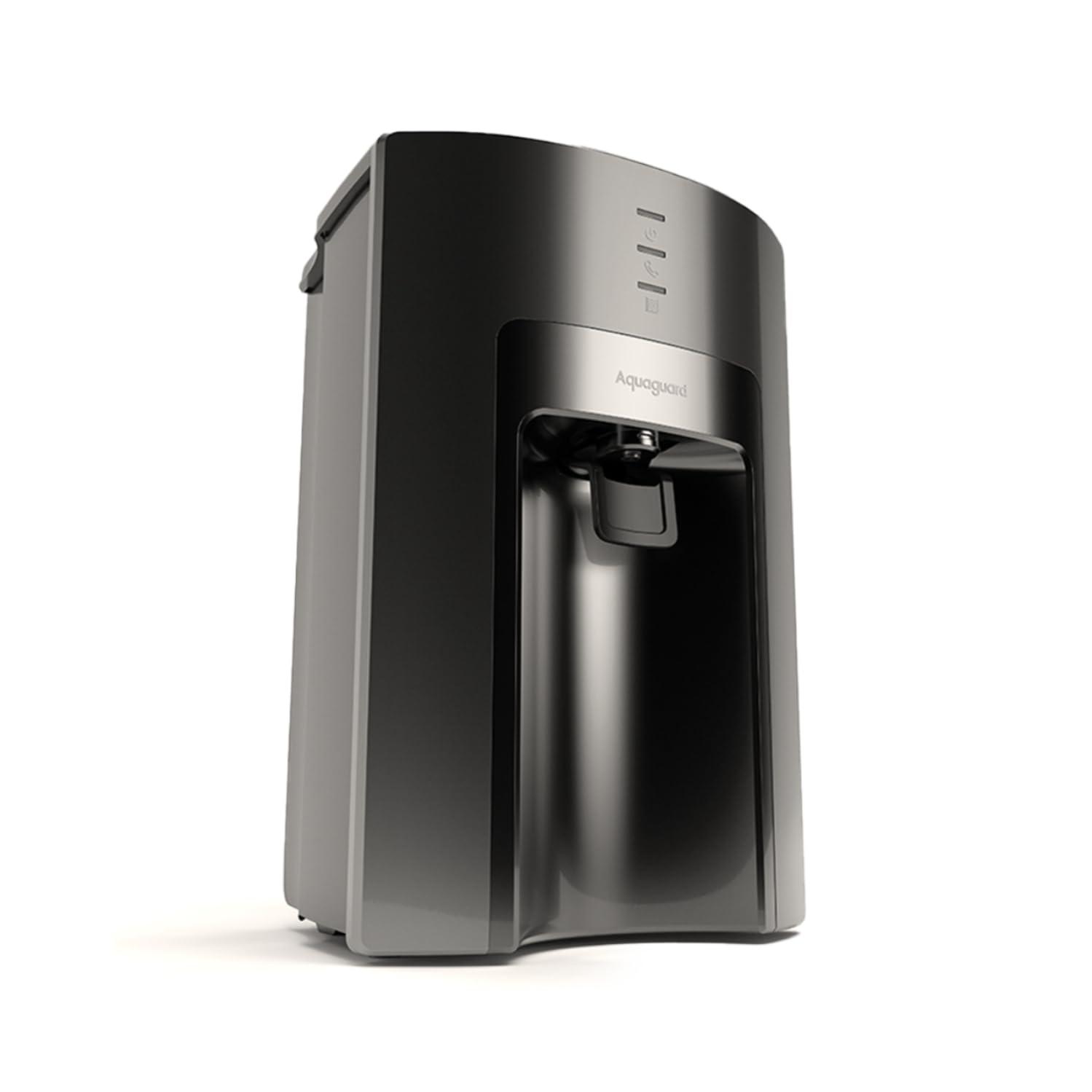
The Aquaguard Delight NXT WS is the best overall pick under ₹10,000 for Indian homes with moderate to high TDS water. Eureka Forbes Aquaguard has been the most trusted water purifier brand in India for over three decades, and this model brings their proven RO technology to the under-₹10,000 segment.
The six-stage purification combines RO, UV, and UF technologies. RO removes contaminants like lead, mercury, microplastics, and pesticides. UV e-boiling ensures every drop is as pure as water boiled for twenty-plus minutes. UF removes ultra-fine particles for crystal-clear water. The Sedi Shield and Particulate Filter handle the rough work of removing dust, dirt, and sediment before the expensive filters even encounter the water.
The six-litre storage tank is sufficient for a family of four to five. Suitable for all water sources including borewell, tanker, and municipal supply. Works with TDS levels up to 2000 ppm.
Five-year total cost: approximately ₹32,000. Annual filter service is ₹2,500 to ₹3,500. The free first-year service plan worth ₹2,000 includes free installation, one free maintenance visit, and unlimited repair visits in year one.
The biggest advantage is Aquaguard's service network. With 17,000-plus pin code coverage, you can get a technician within 24 hours in metros and 48 hours in tier-2 cities. For a product that needs service every six to twelve months for the next five-plus years, this matters more than any other single factor.
The downsides: build quality is functional rather than premium. The cabinet is plastic. The pump produces a noticeable hum during operation that lasts about two to three minutes when refilling the tank. Some buyers report the 6L tank size feels small for joint families with five-plus members.
Best for Water Conservation

If you live in a water-scarce city like Bangalore, Chennai, or much of Hyderabad, water wastage from your purifier matters as much as water purity. Standard RO purifiers waste two to three litres for every clean litre. Over a year for a family of four, this adds up to nearly 7,000 litres of wasted water.
The Aquaguard Delight NXT Aquasaver addresses this directly. Its proprietary Aquasaver technology achieves up to 60 percent water recovery, compared to 25 to 35 percent in standard RO units. Over a year, this saves approximately 4,000 to 5,000 litres of water for a typical four-person family.
The nine-stage purification adds Mineral Charge technology that adds calcium and magnesium back to RO-purified water, addressing one of the genuine complaints about standard RO units. The two-year filter life is exceptional in this segment — most competitors require annual filter changes.
Five-year total cost: approximately ₹26,000. The two-year filter life dramatically reduces ongoing maintenance compared to other RO purifiers. This is the lowest five-year cost in the segment for RO purification.
The trade-off: the unit is slightly bulkier than the standard Delight NXT WS. Installation requires more careful placement to accommodate the larger filtration assembly. Some buyers report initial water taste takes two to three days to stabilise after installation as the mineraliser equilibrates.
Best for Low TDS Municipal Water

If your municipal water TDS is below 300 ppm — which covers most of Mumbai, Pune, and Chennai — full RO is overkill. The Aquaguard Sure Delight RO+UV 2X is purpose-built for this scenario at a lower price point.
The six-stage purification uses RO 2X NanoPore technology that lasts two years and recovers over 40 percent of input water. Combined with UV e-boiling and the Mega Sediment Filter, it handles up to 1000 ppm TDS effectively while being optimised for lower-TDS municipal supplies. The 6L storage tank serves a family of four comfortably.
Five-year total cost: approximately ₹22,000. The two-year filter life makes this one of the most economical purifiers to maintain in this price range.
This is the right choice for Mumbai, Pune, Chennai, parts of Kolkata, and any city where municipal water testing shows TDS consistently below 300 ppm. It is also a strong pick for buyers who want Aquaguard service network reliability without paying for unnecessary advanced filtration.
The trade-off: if you ever move to a high-TDS area or your water source changes, this purifier will be inadequate. Not suitable for borewell water in most tier-2 cities or for tanker water in any city.
Best UV/UF Option for Soft Water Areas
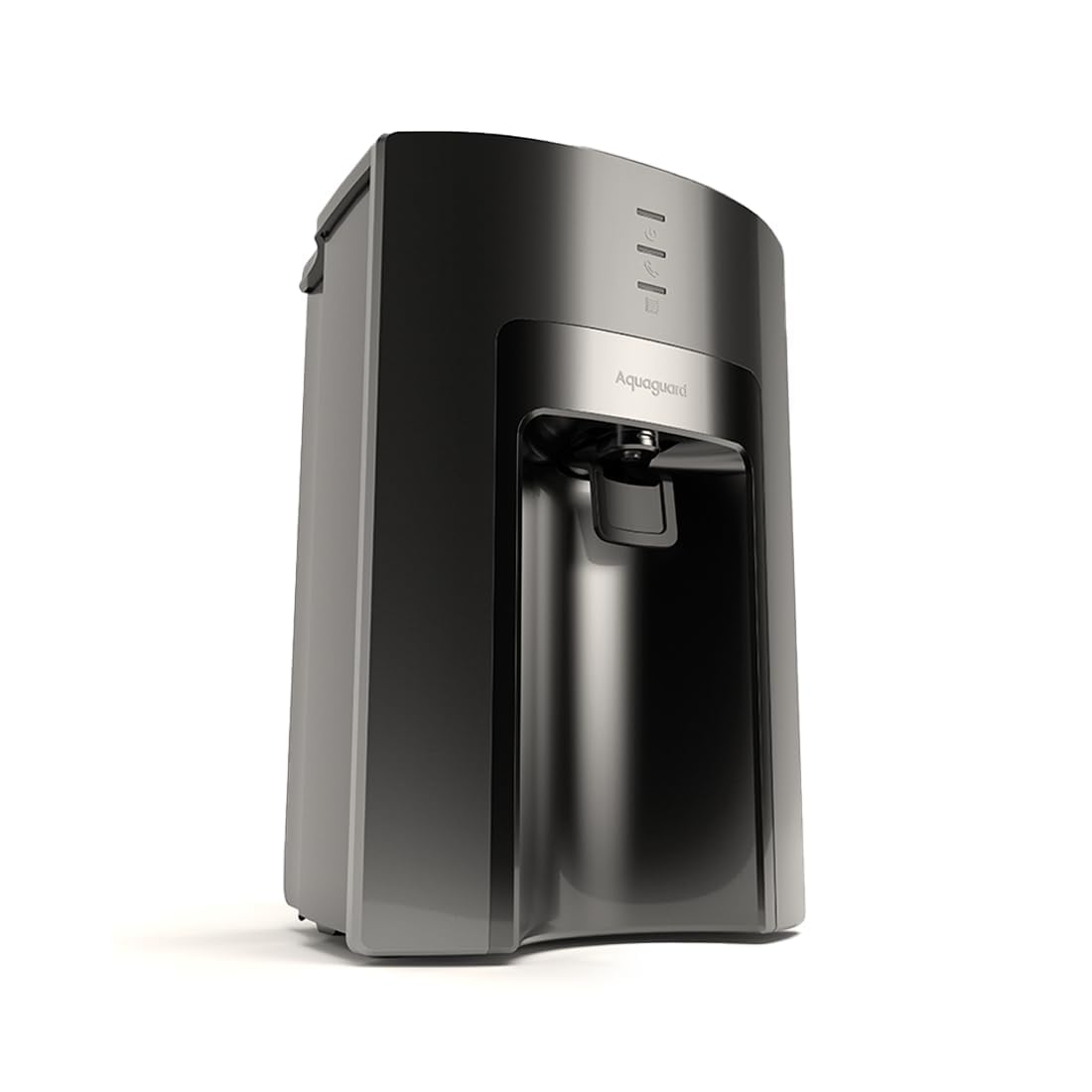
For households where the input water TDS is below 200 ppm consistently — which applies to certain parts of Mumbai, Chennai, and any city with well-managed municipal water — full RO is wasteful. The Aquaguard Sure Delight RO+MC 1X provides RO with Mineral Charge at the lowest entry price into the Aquaguard ecosystem.
The 1X NanoPore RO membrane handles TDS up to 1000 ppm. The Mineral Charge technology adds back essential calcium and magnesium that RO removes, addressing the most common health complaint about standard RO. The six-stage purification still provides 99.9999 percent bacterial reduction and 99.99 percent viral reduction.
Five-year total cost: approximately ₹20,000. This is the absolute minimum spend for genuine Aquaguard service network coverage with RO technology.
The trade-off: lower storage capacity. The 1X filter life is shorter than the 2X variant — expect filter replacement every 12 to 14 months at ₹2,000 to ₹2,500. Not recommended for borewell or tanker water with TDS above 800 ppm.
Best Storage Capacity for Large Families
For joint families and households with five-plus members, storage capacity becomes a real issue. The standard 6L tank from most under-₹10,000 purifiers empties faster than the RO unit can refill it during high-usage periods like morning routines or after meals.
The Aquaguard Delight Aquasaver with stainless steel tank addresses this with a 7L storage capacity. The stainless steel construction is significantly more durable than plastic tanks and does not develop the algae or biofilm issues that older plastic tanks face after two-plus years.
The nine-stage purification combines RO, UV, UF, and Mineral Charge for the most comprehensive treatment in this segment. The Aquasaver technology provides 60 percent water recovery. The two-year filter life keeps ongoing costs low.
Five-year total cost: approximately ₹27,000. The stainless steel tank typically lasts the entire five-year window without replacement, unlike plastic tanks that may need replacement around year four.
The trade-off: this is at the very top of the under-₹10,000 segment with frequent price fluctuations that push it above ₹10,000 during non-sale periods. Worth waiting for an Amazon sale, Aquaguard direct sale, or Diwali offers to land it under budget.
What About Kent, Livpure and HUL Pureit?
Kent dominates the premium segment above ₹10,000 but is harder to find under ₹10,000 in genuinely good models. The Kent Maxx UV at around ₹6,000 is suitable for municipal water only and lacks RO. The Kent Pearl at around ₹14,000 is excellent but exceeds our budget. We recommend stretching to the Kent Grand Plus at around ₹12,500 if your budget allows — it is genuinely one of the best RO purifiers in India.
HUL Pureit is a credible alternative. The HUL Pureit Eco Water Saver achieves the best water recovery in the industry at 1:1 ratio. If water scarcity in your city is a primary concern, look at this as an alternative to the Aquaguard Aquasaver. Pricing is similar at around ₹9,000 to ₹10,000.
Livpure is heavily marketed but service network reliability is significantly behind Aquaguard and Kent. The Livpure Glo Pro Plus at around ₹6,500 is the most popular budget Livpure model, but buyers report booster pump failures within eighteen months that require expensive replacements. We do not recommend Livpure at this price point.
Water Purifier Types Explained — Which One Do You Actually Need
RO stands for Reverse Osmosis. It pushes water through a semi-permeable membrane that removes dissolved salts, heavy metals, lead, mercury, microplastics, and chemical contaminants. Best for high TDS water above 300 ppm. Wastes 50 to 75 percent of input water in standard models, 20 to 40 percent in water-saving models.
UV stands for Ultraviolet. It uses UV-C light to kill bacteria, viruses, and microorganisms. Does not remove dissolved salts, chemical contaminants, or heavy metals. Best for treated municipal water with TDS below 300 ppm.
UF stands for Ultrafiltration. Uses a fine membrane to physically block bacteria, cysts, and large microorganisms. Does not remove dissolved salts. Often paired with UV for redundancy. Suitable for municipal water.
MF stands for Microfiltration. Removes suspended particles and large bacteria. Mainly used as a pre-filter to protect other purification stages.
MC stands for Mineral Charge or Active Copper. Adds calcium, magnesium, or copper ions back to RO-purified water. Addresses the common complaint that RO water lacks healthy minerals. Optional but health-positive.
UV LED is the newest technology — solid-state UV lamps that last longer than traditional UV bulbs and consume less power. Available in some Kent and Aquaguard premium models above ₹15,000.
City-by-City Water Source Reality
Mumbai municipal water averages 150 to 250 ppm TDS, well below RO threshold. UV+UF is sufficient for most apartments. RO becomes useful only in older buildings with tank issues.
Delhi NCR municipal water varies wildly — Lutyens Delhi and central areas average 200 to 400 ppm, while Gurugram, Noida, and outer Delhi commonly cross 800 ppm. Borewell and tanker water in NCR often exceeds 1200 ppm. Most NCR homes need RO.
Bangalore borewell water typically tests 250 to 600 ppm. The increasing reliance on tanker water for newer apartments pushes TDS above 700 ppm in many cases. RO recommended.
Chennai municipal water averages 200 to 350 ppm in most areas. Edge cases include coastal areas where TDS can spike due to salt intrusion. UV+UF generally sufficient.
Hyderabad water varies enormously by neighbourhood. Central Hyderabad and Hi-Tec City often see 300 to 500 ppm. Outer suburbs and Gachibowli can exceed 800 ppm. Test your specific source.
Kolkata municipal water generally tests below 200 ppm in central areas. Edge cases include peri-urban areas with borewell supply. UV+UF generally adequate.
Pune water averages 150 to 300 ppm in most municipal supplies. Suitable for UV+UF in most cases unless you receive tanker water.
Tier-2 cities like Jaipur, Lucknow, Indore, and Patna almost universally rely on borewell water with TDS above 400 ppm. RO recommended.
Installation, Maintenance and Common Mistakes
Install the purifier near the water source to minimise plumbing runs. Long pipe runs through hot kitchen environments can lead to algae growth in the input pipes within months. Direct sunlight on the purifier itself accelerates plastic degradation and should be avoided.
Run the purifier through three full tank cycles before drinking the first water. Initial water from any new RO unit carries trace impurities from manufacturing and shipping that should be flushed out.
Service your purifier on schedule. The annual service is genuinely necessary, not just a maintenance racket. Filters that look fine externally can be heavily contaminated internally. Skipping annual service to save ₹3,000 often results in ₹8,000 in repair costs the following year.
Do not use generic third-party filters in branded purifiers. They typically do not seal correctly, allowing unfiltered water to bypass the filtration entirely. The savings of ₹500 to ₹1,000 per filter replacement are not worth the risk.
Replace the RO membrane on schedule even if the purifier seems to be working. Membrane degradation is gradual and not visible externally. Old membranes pass increasingly more contaminants without obvious symptoms.
The Honest Verdict
For most Indian homes with moderate to high TDS water, the Aquaguard Delight NXT WS is the right choice. Aquaguard's service network is the single most important factor for a product you will own for five-plus years, and this model delivers proven RO+UV+UF technology at a fair price.
If you live in a water-scarce city or care about water wastage, the Aquaguard Aquasaver variant is worth the extra cost. The 60 percent water recovery saves enough water annually to justify the price difference.
If your municipal water is consistently below 300 ppm TDS, the Aquaguard Sure Delight RO+UV 2X provides adequate purification at a lower cost without the unnecessary RO membrane wear.
If you have a joint family with five-plus members, the stainless steel tank variant with 7L capacity handles peak usage better.
The category to avoid entirely is unbranded water purifiers under ₹5,000 sold on Amazon or local electronics shops. They lack service support, use substandard filters that need replacement every three to four months, and frequently fail within 18 months without warranty coverage. Save your money and either skip the purifier or stretch the budget to the Aquaguard Sure Delight RO+MC at ₹7,499.
Common Questions
Do I need an RO purifier if my municipal water tastes fine? Taste is not a reliable indicator of water quality. Dissolved heavy metals, pesticides, and pharmaceutical residues are tasteless. If your TDS is above 300 ppm, you need RO regardless of taste. If TDS is below 200, UV+UF is sufficient for bacterial and viral safety.
How often should I get my water purifier serviced? Once a year minimum, twice a year ideal. Filter replacements depend on usage and source water — typically every 12 months for standard RO, every 24 months for premium models with 2-year filter life claims.
Can I install a water purifier myself? Most branded purifiers require professional installation that is included in the price. Self-installation voids warranties and often results in leaks or incorrect plumbing connections. The free installation included with Aquaguard purchases is genuinely worth using.
Does an RO purifier remove all minerals from water? Standard RO removes 90 to 99 percent of dissolved minerals. Modern RO purifiers with Mineral Charge or Copper technology add back essential calcium, magnesium, and copper after RO purification. If mineral retention matters to you, look specifically for these features.
How long does a water purifier last in India? With proper annual servicing, the body and pump typically last seven to ten years. Filters and membranes need regular replacement throughout that period. The single biggest cause of premature failure is voltage fluctuation damaging the booster pump — consider a voltage stabiliser if your area sees frequent voltage swings.
What is the difference between Mineral Charge and Active Copper? Mineral Charge adds back calcium and magnesium that RO removes. Active Copper additionally adds copper ions which have antimicrobial properties. Active Copper is a premium feature typically available in purifiers above ₹12,000.
Final Buying Checklist
Before ordering any water purifier in India, run through this checklist. Test your water TDS with a ₹250 meter to confirm whether RO is actually needed. Confirm the brand has service centres in your city — check their website for serviceable pin codes. Verify the storage tank capacity matches your family size — 6L for up to four people, 7L for five-plus. Read the filter replacement schedule and calculate five-year ownership cost including service. Confirm warranty terms — most purifiers offer one-year warranty with optional extended warranty plans worth considering.
Get the right purifier matched to your water source and family size, and it will deliver safe drinking water for years. Get the wrong one or buy on price alone, and you have a noisy plastic box that needs expensive repairs every six months.