Most Indian families buying air purifiers have no clear idea what they are actually buying. The sales pitch sounds simple — HEPA filter removes pollution, problem solved. The reality is more interesting, more complicated, and far more useful to understand before you spend ₹10,000 to ₹40,000 on the appliance.
This guide explains how air purifiers actually work, what they do not do, and why this matters for Indian homes specifically. We are not selling you anything in this post. There are no product recommendations, no Amazon cards, and no affiliate links. Once you genuinely understand the mechanism, you will make better buying decisions, use your purifier more effectively, and stop falling for marketing claims that range from misleading to outright wrong.
By the end of this read, you will understand the four-mechanism science of HEPA filtration, why the famous "99.97 percent" claim is more nuanced than it sounds, what air purifiers physically cannot do regardless of price, and the specific ways Indian pollution differs from the Western data most product marketing relies on.
What an Air Purifier Actually Is
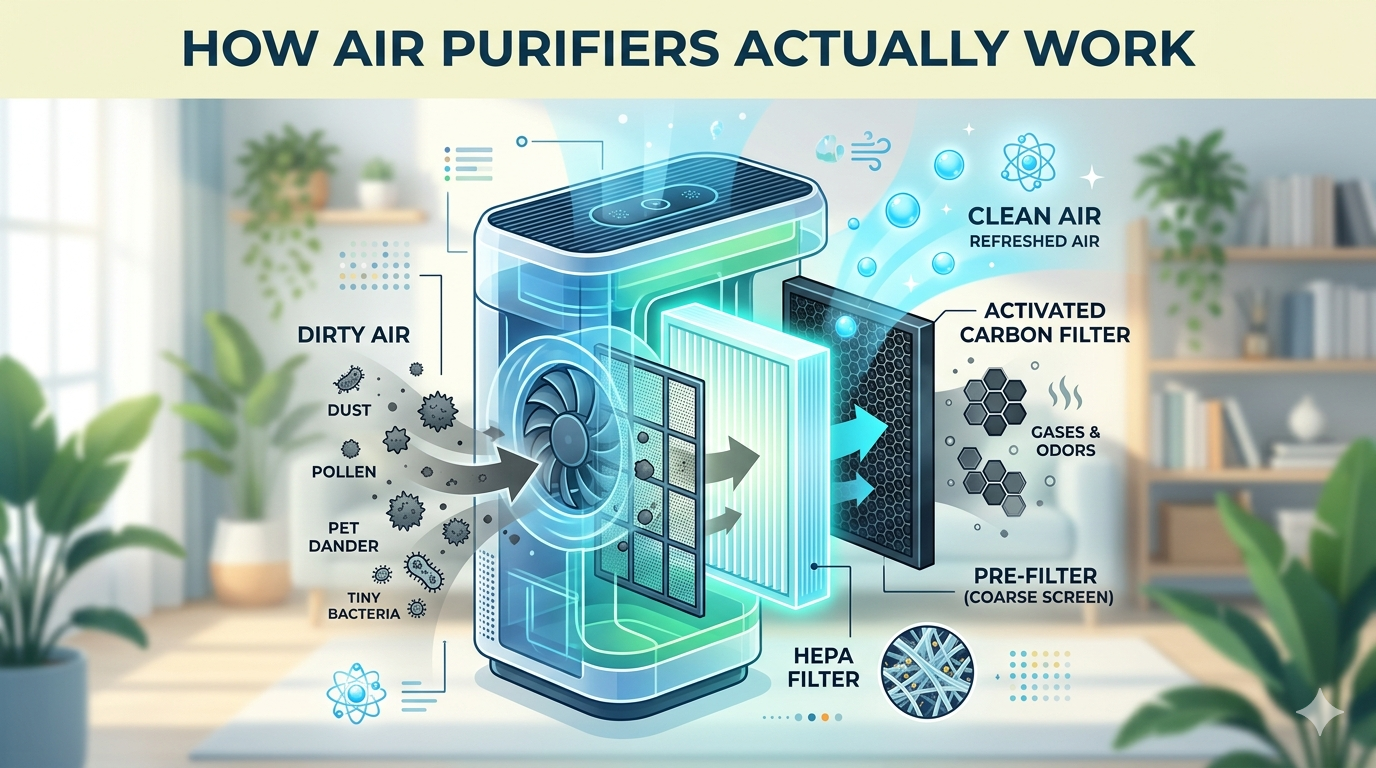
At the most basic level, an air purifier is a fan that pushes air through one or more filters. The filters trap unwanted particles. The clean air exits back into the room. The dirty particles stay in the filter until it gets full enough that you replace it.
That is the entire concept. Everything else — smart features, app integration, LED displays, Plasmacluster ions, UV-C lights, anti-bacterial coatings — sits on top of this core mechanism. Some of those additions provide real benefits. Most are marketing differentiation rather than functional improvement.
The core question for any purifier is therefore simple. How effectively does the fan move air through the filter, and how effectively does the filter trap the particles you care about?
This is measured by two specifications. CADR (Clean Air Delivery Rate) measures how many cubic metres per hour of clean air the unit produces. Filter grade measures what percentage of which particle sizes the filter actually captures. Get these two numbers right for your room and pollution conditions, and you have a working air purifier. Everything else is decoration.
The Four Capture Mechanisms (Why Filters Work Better Than You Think)
HEPA filters do not work the way most people imagine. The intuitive mental model is that the filter has tiny holes, and particles smaller than the holes pass through while bigger particles get stuck. This model is wrong, and understanding why it is wrong explains why HEPA filtration is so effective.
A True HEPA filter is rated to capture 99.97 percent of particles at 0.3 microns in size. What confuses many buyers is that the filter actually captures particles smaller than 0.3 microns with even greater efficiency. This sounds impossible if you imagine the filter as a sieve. It makes sense once you understand the actual mechanisms.
There are four physical mechanisms by which particles get trapped in a HEPA filter, and they each work best on different particle sizes.
The first mechanism is sieving, which works exactly as you would expect. Particles larger than about one micron physically cannot pass between the fibres in the filter mesh. They get blocked at the surface. This handles large dust particles, pollen grains, and visible debris.
The second mechanism is interception. Particles between roughly 0.5 and one micron travel in the air stream but come close enough to the filter fibres that they touch and stick. This is similar to how a leaf gets caught on a wet windscreen wiper even though the wiper is not specifically catching it.
The third mechanism is inertial impaction. Larger particles between roughly 0.4 and one micron have more mass and momentum. When the air stream curves around a filter fibre, these heavier particles cannot change direction fast enough and crash into the fibre instead of flowing past.
The fourth mechanism is diffusion. Very fine particles below 0.1 microns are so small that they get knocked around randomly by air molecules through Brownian motion. They wobble through the filter on a chaotic path and eventually hit a fibre by random chance. The smaller the particle, the more it wobbles, the more likely it eventually contacts a fibre.
The result of these four overlapping mechanisms is counterintuitive. The hardest particle size to capture is around 0.3 microns. This is the sweet spot where particles are too small for effective inertial impaction, too large for strong diffusion effects, and just slippery enough to thread through interception zones. This is why HEPA filters are tested specifically at 0.3 microns — it is the worst case, not the best case. Particles smaller than 0.3 microns and particles larger than 0.3 microns are both captured at higher efficiency than the rated 99.97 percent.
This is why HEPA filters effectively capture virus particles around 0.1 microns despite those particles being smaller than the rated filtration size. The diffusion mechanism handles them efficiently.
What "99.97 Percent" Actually Means in Indian Conditions
The famous 99.97 percent capture rate sounds impressive. It is also widely misunderstood in product marketing.
The number applies to particles passing through the filter in a single pass. It does not mean your room air becomes 99.97 percent cleaner the moment you switch on the purifier. Particles in your room that have not yet passed through the filter remain in the air. The purifier needs to circulate the entire room's air volume multiple times through its filter to actually achieve meaningful reduction in airborne pollution.
This is what CADR measures. If your room is 30 cubic metres and your purifier has a CADR of 300 cubic metres per hour, the purifier theoretically processes the room air ten times in one hour. In practice, due to airflow dead zones, door gaps, and ongoing pollution infiltration, the realistic figure is more like five to seven full air changes per hour.
A 2019 study published in the International Journal of Environmental Research and Public Health, conducted by researchers at the National Institute of Standards and Technology, modelled HEPA filter effectiveness in urban Delhi households. They found that all-day HEPA filter use reduced annual mean PM2.5 personal exposure from 103 micrograms per cubic metre to 29 micrograms per cubic metre — a reduction of 72 percent. Eight-hour daily use only achieved exposures in the 39 to 40 micrograms per cubic metre range, still above the WHO Indoor Air Quality Guideline of 35 micrograms per cubic metre.
The takeaway from this research is significant. To achieve genuine health benefit in Delhi pollution conditions, the purifier needs to run for 15-plus hours daily. Switching it on for a few hours when you remember produces token improvement rather than meaningful exposure reduction.
What Air Purifiers Cannot Do (Important Limitations)
Understanding limitations is as important as understanding capabilities. Air purifiers do not work miracles, and marketing claims often obscure what they physically cannot achieve.
Air purifiers do not add oxygen to the air. Sealed rooms with continuous purifier operation over many hours can produce mildly stale air with elevated carbon dioxide from human respiration. Periodic ventilation remains important even with a running purifier.
Air purifiers do not remove gases. HEPA filtration captures particles, not gas molecules. Volatile organic compounds, formaldehyde, ozone, carbon monoxide, and most chemical odours pass straight through a HEPA filter. This is why higher-quality purifiers add activated carbon stages. Carbon adsorbs gas molecules onto its highly porous surface. Without a substantial carbon layer, a purifier cannot meaningfully address cooking smoke odours, mosquito coil emissions, agarbatti fumes, or paint fumes.
Air purifiers cannot remove pollution faster than your room creates it. If you are running a gas stove without exhaust ventilation, smoking indoors, or burning incense, the purifier is fighting an active pollution source. The purifier will still help, but you will achieve far better air quality by addressing the source rather than just trying to filter its output.
Air purifiers do not work effectively in large, open spaces. A unit rated for 250 square feet will struggle in a 500 square foot open-plan living room with high ceilings. The air simply does not circulate through the filter quickly enough.
Air purifiers do not eliminate dust accumulation on surfaces. They reduce airborne dust, which means less dust eventually settles on furniture. They do not remove dust that has already settled or dust generated by activity in the room.
Air purifiers do not work when windows are open. Open windows continuously introduce fresh outdoor pollution faster than the purifier can clean it. In Indian conditions, an air purifier running with open windows is essentially decoration.
Why Indian Pollution Is Different
Most air purifier marketing relies on data from Western markets. American and European indoor air typically has different pollutant profiles than Indian indoor air, and this affects which features actually matter for your home.
Indian outdoor PM2.5 levels are dramatically higher than the markets where most air purifier brands originate. WHO data shows India's annual population-weighted mean PM2.5 exposure at approximately 90 micrograms per cubic metre. WHO safe threshold is 5 micrograms per cubic metre. Delhi sits four to twenty times above that threshold depending on the season. Mumbai sits four to eight times above. Even Bangalore, considered moderate by Indian standards, sits at three to five times the WHO threshold during winter months.
This matters because Western purifiers are typically designed and rated for source environments where outdoor PM2.5 levels rarely exceed 25 micrograms per cubic metre. A purifier that works adequately in London or San Francisco may be undersized for Delhi, even at the same CADR rating. The unit needs to do more work continuously to keep pace with higher ambient infiltration.
Indian cooking produces different and more intense particulate loads than Western cooking. The tadka stage of Indian cooking — hot oil with mustard seeds, cumin, dried chillies, and curry leaves — releases significant smoke and aerosolised oil droplets. Western cooking generally produces lower-intensity particulate emissions over longer time periods. The result is that Indian kitchens need air purifiers with stronger activated carbon stages than Western kitchens for equivalent odour control.
Indian humidity ranges affect filter performance differently than dry climates. Mumbai's 70 to 85 percent humidity through monsoon season can cause activated carbon filters to absorb water along with target gases, reducing carbon capacity. Some carbon filters in Indian conditions need replacement more frequently than the manufacturer's rated life. This is not a manufacturing defect — it is a real-world performance difference caused by climate.
Indian voltage fluctuations affect motor lifespan. Western electrical supplies are remarkably stable compared to most Indian supplies. The booster motors and electronic controllers in air purifiers can degrade faster under frequent voltage swings. Areas with regular voltage fluctuations should consider running purifiers through a stabiliser, particularly in tier-2 cities.
Indian dust composition differs from Western dust. Indian outdoor dust contains a higher proportion of mineral particulate matter from construction, agricultural activity, and dry surfaces during summer. This affects how quickly pre-filters clog and how often they need cleaning. Western purifier manufacturers' guidance of pre-filter cleaning every two months may be insufficient for Indian conditions where monthly cleaning is more realistic.
The Pre-Filter Stage Most People Ignore
Every quality air purifier has a pre-filter as the first stage. This is a coarser filter, often washable, designed to catch the large particles that would otherwise prematurely clog the more expensive HEPA filter behind it.
Pre-filter maintenance is the single most important thing most Indian air purifier owners get wrong. The pre-filter catches hair, large dust, pollen, fabric fibres, and other coarse particles. As it fills with these particles, airflow through the entire system decreases. The purifier has to work harder to push air through the increasingly clogged pre-filter. Eventually, large particles start to bypass the pre-filter and accumulate on the HEPA filter behind it, dramatically shortening HEPA filter life.
The recommendation in product manuals is typically to clean the pre-filter every two months. In Indian conditions, especially in dusty cities or homes with pets, monthly cleaning is more realistic. The cleaning is simple — vacuum it gently or wash with water and let it dry completely before reinserting.
Doing this single thing extends HEPA filter life by 30 to 50 percent. Across a five-year ownership period, this can save thousands of rupees in filter replacement costs.
The Activated Carbon Stage Most Buyers Underspec
The activated carbon stage handles gases and odours that HEPA filtration cannot touch. This includes cooking smoke aromas, mosquito coil emissions, perfume residue, paint fumes, formaldehyde from new furniture, and the general "stuffiness" of a closed apartment.
Activated carbon works through adsorption rather than filtration. The carbon's microscopic pore structure provides enormous surface area for gas molecules to attach to. A single gram of activated carbon can have a surface area equivalent to a football field due to its microporous structure.
The catch is that carbon stages in cheaper purifiers are often inadequate. Marketing may claim "activated carbon filter" but the actual carbon mass might be only 100 to 200 grams. Effective gas adsorption for Indian cooking conditions requires 500-plus grams of carbon. The very cheap purifiers under ₹5,000 typically have token carbon layers that provide minimal real-world odour removal.
For Indian homes where cooking smoke matters, prioritise the carbon stage mass over headline HEPA grade. An H13 HEPA with substantial carbon outperforms an H14 HEPA with minimal carbon for typical Indian household pollution mixes.
Ionisers, UV-C Lights, and Other Add-Ons
Beyond the basic HEPA-and-carbon configuration, many purifiers add additional technologies marketed as superior purification.
Ionisers release charged ions into the room air. These ions attach to airborne particles, giving them an electrical charge that makes them stick to walls, furniture, or special collection plates. Ionisers do reduce airborne particle counts, but they do not remove the particles from the room — they just move them from the air onto surfaces. There is also evidence that some ioniser models produce small amounts of ozone as a byproduct, which is itself a health concern.
UV-C lights kill microorganisms passing through the purifier. The technology works, but the dwell time as air rushes past the UV lamp at high airflow speeds may not be sufficient for guaranteed pathogen kill on a single pass. UV-C is most useful in continuously circulated air over many cycles, not as a single-pass disinfection mechanism.
Plasmacluster ions, used in some Sharp purifiers, release positive and negative ions into room air that interact with airborne contaminants. The technology has independent certifications from organisations like the British Allergy Foundation and IIT Delhi for specific applications. It is genuinely different from standard HEPA-only purification, though its real-world impact varies by room conditions.
The honest assessment for these add-ons is that they provide marginal additional benefit on top of solid HEPA-and-carbon foundations. They should not be the primary reason to choose one purifier over another. A well-sized HEPA-and-carbon unit without any of these add-ons will outperform a poorly-sized unit with all of them.
When You Actually Need an Air Purifier
Not every Indian home needs an air purifier. This is something Indian product marketing rarely admits.
You probably need an air purifier if you live in Delhi, Gurugram, Noida, Lucknow, Patna, Kanpur, Faridabad, or other high-pollution cities. Outdoor PM2.5 levels here regularly exceed safe thresholds by multiple times. Indoor air without filtration is consistently unhealthy.
You probably need an air purifier if anyone in your household has asthma, allergies, COPD, or other respiratory sensitivities. Even moderate pollution levels meaningfully affect these conditions.
You probably need an air purifier if you have young children or elderly parents. Their respiratory systems are more vulnerable to particulate pollution than adults in robust health.
You probably need an air purifier if your home has unavoidable indoor pollution sources — heavy cooking without exhaust ventilation, smokers in the household, regular use of mosquito coils or agarbattis, or proximity to outdoor pollution sources like a busy road or construction site.
You probably do not need an air purifier if you live in low-pollution areas like much of Kerala, coastal Karnataka, or remote hill stations. Outdoor PM2.5 levels here typically sit within WHO safe ranges most of the year.
You probably do not need an air purifier if your home has excellent natural ventilation and you regularly open windows during clean-air hours. In low-to-moderate pollution areas, ventilation accomplishes much of what purification would achieve at zero ongoing cost.
You probably do not need a premium purifier if your overall indoor air is already reasonable. A ₹5,000 air purifier providing modest filtration is far better than no purifier. A ₹40,000 premium unit may not provide proportionally better health outcomes for the additional ₹35,000 spend.
How to Verify Your Purifier Is Actually Working
Buying an air purifier and assuming it works is not enough. There are concrete ways to verify performance.
The simplest test is the PM2.5 meter test. Budget PM2.5 meters cost around ₹2,000 to ₹3,000 on Amazon India. Measure your room PM2.5 before turning the purifier on. Run the purifier on high setting for one hour. Measure again. A working purifier should show measurable reduction. If you see no change, something is wrong with the purifier, the filter, or the placement.
The visible test is the candle test. Light a candle in a sealed room. Let the smoke disperse for a minute. Switch on the purifier. A working unit should noticeably clear visible smoke within five to ten minutes. This is a rough test but demonstrates basic functionality.
The airflow test is the simplest of all. Hold your hand near the air outlet. You should feel clearly noticeable airflow. If the airflow is weak despite the unit running on high setting, the pre-filter is clogged, the HEPA is exhausted, or the fan motor is degrading.
The smell test detects activated carbon failure. If your purifier no longer reduces cooking smoke odours that it previously handled, the carbon stage is saturated and needs replacement, even if the HEPA filter still has rated life remaining.
Common Questions
How long should I run my air purifier daily? Based on Delhi pollution research, 15-plus hours daily delivers meaningful health benefit. Eight hours of daily use provides token improvement but does not bring annual PM2.5 exposure below WHO thresholds in high-pollution cities. In moderate-pollution cities, 8 to 12 hours daily may be sufficient.
Should I close all doors and windows when running an air purifier? Yes, while it is actively running. Open windows continuously introduce outdoor pollution faster than the purifier can clean it. Ventilate periodically when outdoor air quality is genuinely good — typically early morning in less polluted cities.
Do air purifiers help with viruses and bacteria? HEPA filters do physically trap virus and bacteria particles. However, an air purifier alone is not a substitute for other infection control measures. It reduces airborne pathogen load, which is helpful but not transformative.
Why is my electricity bill higher after getting an air purifier? Running a purifier continuously consumes 30 to 70 watts depending on the model and fan speed. Over 24 hours that translates to roughly 0.7 to 1.7 units of electricity daily, costing ₹150 to ₹350 monthly at typical Indian residential tariffs. This is normal and unavoidable for continuous purifier operation.
Is HEPA-type or HEPA-grade as good as True HEPA? No. "HEPA-type" and "HEPA-grade" are marketing terms with no defined standards. Only "True HEPA" or specific grades like H13 or H14 have certified performance ratings. The difference matters — HEPA-type filters may capture only 85 to 95 percent versus 99.97-plus percent for True HEPA.
Can I use my air purifier in a humid bathroom? Most consumer air purifiers are not designed for high-humidity bathroom environments. The filter media can absorb water, the electronics are not waterproofed, and humidity exceeding 70 percent for extended periods can damage components. Use a dedicated bathroom exhaust fan for humid environments.
The Bottom Line on How Air Purifiers Work
An air purifier is a fan moving air through filters. The HEPA filter captures particles through four physical mechanisms that work most effectively at particle sizes both larger and smaller than the worst-case 0.3 micron rating. Carbon stages capture gases that HEPA cannot. Pre-filters protect HEPA from premature clogging. Everything else is on top of this foundation.
For Indian homes specifically, the practical implications are clear. Run the purifier for 15-plus hours daily in high-pollution cities to achieve meaningful health benefit. Clean the pre-filter monthly, not bi-monthly. Prioritise carbon stage mass for cooking smoke control. Verify performance with a PM2.5 meter rather than trusting the marketing.
Understanding these mechanisms changes how you choose a purifier, how you operate it, and what you should and should not expect from it. You are now equipped to evaluate any air purifier on the market based on what it actually does rather than what its marketing claims.
When you are ready to actually buy a unit for your Indian home, our complete buying guide covers the four air purifiers under ₹15,000 that genuinely deliver on these mechanisms — with specific recommendations matched to room sizes, city pollution profiles, and household needs. You can read it here: [Best Air Purifiers Under ₹15,000 in India 2026 (Tested)](/post/best-air-purifiers-under-15000-india-2026).